
Meringue Won't Whip
Your egg whites will not form peaks because fat contamination is collapsing the foam. Cleaning the bowl and adding an acid stabilizer lets the proteins whip properly.
Part of baking cooking fixes .
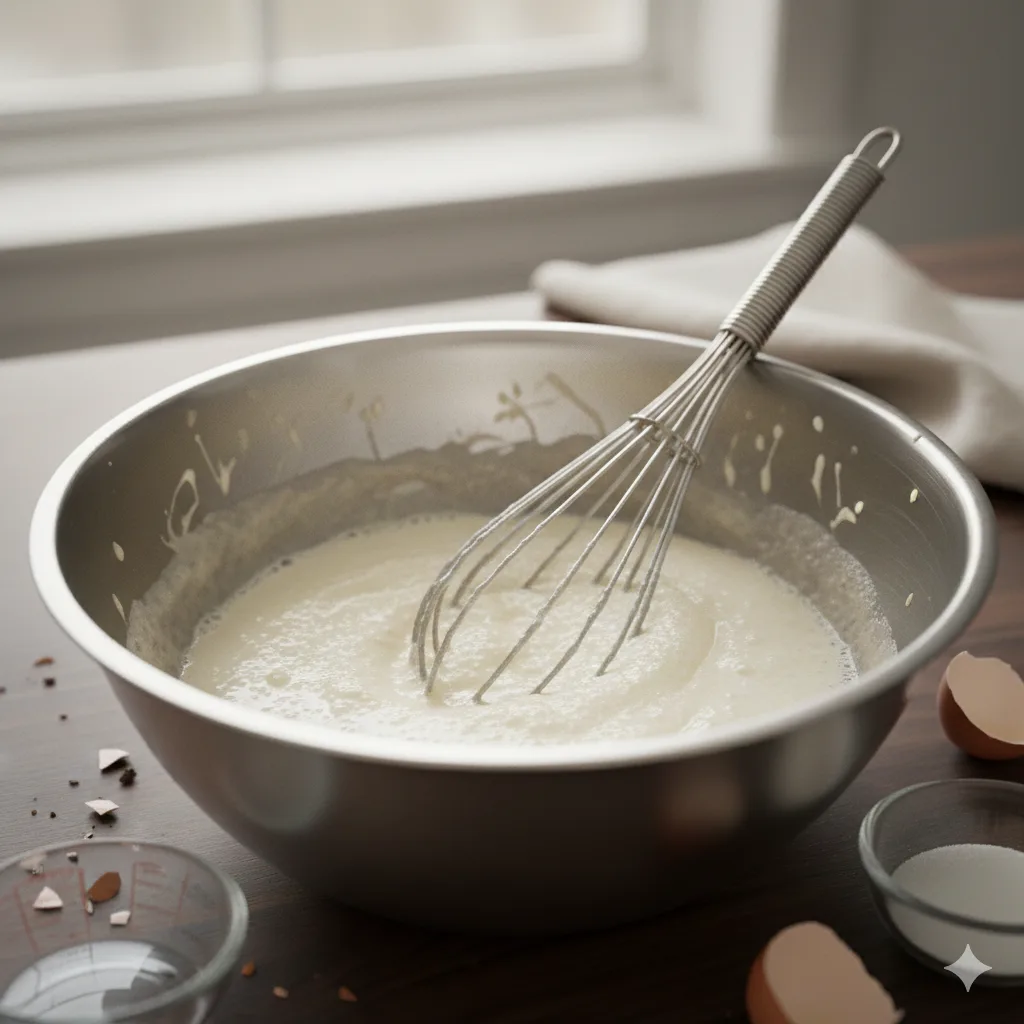
Ingredients on hand
- egg whites (room temperature)
- sugar
- cream of tartar
- white vinegar or lemon juice
Why it happened
Egg white foam is a network of unfolded proteins (mainly ovalbumin and ovotransferrin) that trap air bubbles. Even a trace of fat, including a speck of yolk, disrupts this network because fat molecules wedge between the proteins and prevent them from linking together. Cream of tartar (an acid) lowers the pH, which makes the proteins unfold more easily and bond more tightly around air bubbles.
The fix
- 1 wipe the bowl and whisk attachment with white vinegar on a paper towel, then dry completely
- 2 add 1/4 teaspoon cream of tartar per 2 egg whites and begin whipping on medium speed
- 3 once soft peaks form, add sugar 1 tablespoon at a time while beating on medium-high until stiff, glossy peaks hold when the whisk is lifted
If it's still wrong
- Start completely over with fresh eggs and guaranteed clean equipment.
- Use pasteurized carton egg whites, which have zero yolk contamination.
Prevent next time
- Separate eggs when cold (the yolk is firmer and less likely to break), then let whites warm to room temperature before whipping.
- Always use a metal or glass bowl; plastic bowls retain grease in microscopic scratches even after washing.
Notes
Why this works
Egg whites are about 90 percent water and 10 percent protein. When you whip them, the mechanical action unfolds (denatures) the proteins, exposing hydrophobic regions that were previously hidden inside the protein coil. These hydrophobic regions orient toward air bubbles while the hydrophilic regions stay in the water phase, creating a stable foam.
Fat destroys this system because fat molecules are also hydrophobic. They compete with the proteins for space at the air-water interface and do a poor job of stabilizing it, so bubbles pop faster than they form. Even 0.1 percent fat contamination can prevent meringue from whipping.
Cream of tartar (potassium bitartrate) works by lowering the pH from about 9 to about 8. At this lower pH, the egg white proteins denature more readily and form stronger, more elastic bonds around air bubbles. The result is a foam that whips faster, holds more air, and resists collapsing. Adding sugar gradually is important because sugar dissolves into the water phase and increases viscosity, which strengthens the bubble walls. Adding it too early slows whipping; adding it too late means it cannot dissolve properly, leading to a gritty meringue.
Substitutions
- cream of tartar → 1/2 teaspoon lemon juice per 2 egg whites
- granulated sugar → superfine sugar (dissolves faster)
Other baking fixes